A museum for the idea that the world can be made differently.
I. Mission
To explain how inventions changed civilisation.
A list of objects tells you what people made. It does not tell you how a printed page altered who could hold power, or how a needle that points north reshaped the maps of the sea. We trace the chain of cause and consequence behind each invention, from the conditions that made it possible to the habits, laws and fortunes it set in motion.
II. Approach
Seven chapters, and an honest account of what is known.
Every exhibition follows the same seven chapters, so each invention can be read against the same questions. Each date and attribution is marked as documented, approximate or disputed. Where the record is thin, we say so plainly rather than smoothing it over.
III. Independence
Illustrative images, never fabricated archives.
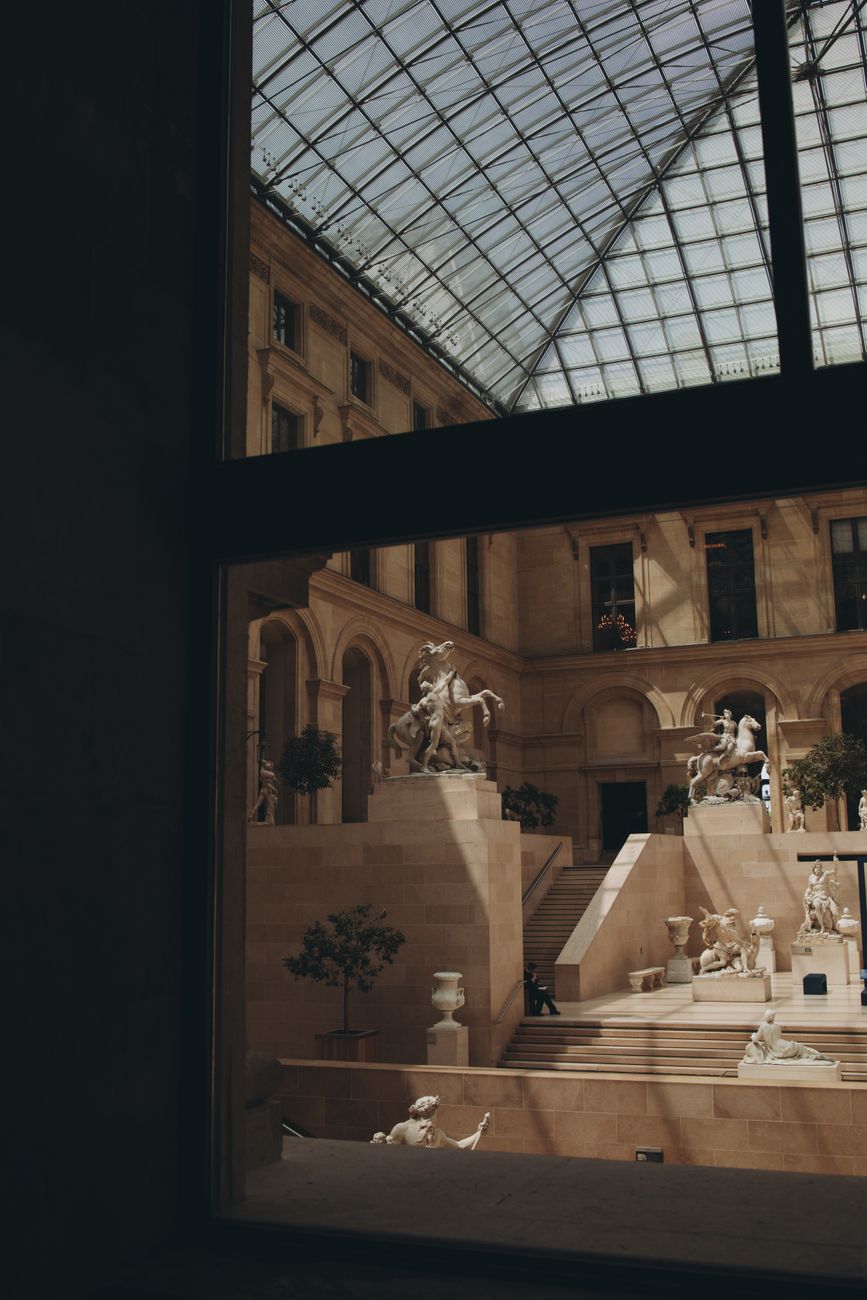
The photographs in this museum are illustrative. They set a mood and a scale, and they are not presented as documents from the events they accompany. We do not invent letters, drawings or archival material to fill a gap. Where a source is missing, the museum shows the gap.
Plate 03. A courtyard beneath glass. Illustrative photography, not a documentary record.Photograph: Margarita, Pexels
About · Our method
Our method.
A museum is only as trustworthy as the account it gives of its objects. These are the rules we keep when we date, attribute and describe an invention.
How we mark certainty
Every invention carries one of three stamps. The stamp tells you how firmly the record supports its date and attribution.
●Documented date
The date, maker and place rest on primary evidence that survives: a dated patent, a signed drawing, a letter, or the object itself. We state the date without qualification.
◐Approximate date
The date or attribution is inferred from secondary evidence, such as a later account, a dated copy, or the style of surviving work. We give a range or a qualified year and say what the estimate rests on.
○Disputed attribution
Sources conflict over who made the invention, or when. We do not choose a winner. We set out each claim and the evidence for it, and leave the reader to weigh it.
The seven chapters of every exhibition
Each exhibition follows the same sequence, so that inventions can be compared on equal terms.
IWorld beforeThe conditions, materials and needs that existed before the invention.
IIHuman achievementThe people, workshops and institutions that produced it, and what they built.
IIIUnderstanding the inventionHow it works, explained in plain terms with the principle made visible.
IVTransformationThe changes in work, travel, knowledge or daily life that followed.
VBefore vs afterA side-by-side account of what changed, with the limits of the comparison stated.
VIIts legacyWhat the invention still shapes today, and what later work it made possible.
VIIHuman storiesThe individuals behind it, including those whose names were never recorded.
What we will not do
–We never invent quotations. Every line attributed to a person is taken from a documented source, and that source is cited.
–We never name a single inventor where credit is shared. Where several people contributed, each is named with their part.
–We never present generated or stock imagery as archival photography. Every plate is labelled with its true origin.
A note on the artifact viewer
The three-dimensional artifact on the home page is an interpretive digital model. It was built from documented drawings and descriptions. It is not a scan of a museum object, and it should not be read as one.
Colophon
Credits
Photography, via Pexels
01Enes Yoldaş
02Margarita
03Thilina Alagiyawanna
04Erik Mclean
05Jaiju Jacob
06Masood Aslami
07ebuyıldız
08freestocks.org
09Kirandeep Singh Walia
10Nicolas Foster
11Brett Sayles
12Artem Podrez
13Sandra Hollerwöger-Minarik
Typography
Cormorant Garamond for display type and DM Sans for navigation, captions and text. Both are set in the Google Fonts collection under the SIL Open Font License.
3D and shaders
Artefact and hall renders use Three.js with physically based materials. The stone, bronze and film-grain surfaces are custom GLSL shaders written for this site, with a static fallback for devices without WebGL.
Design
Catalogue numbering, plate captions and the palette of ivory, paper, charcoal, bronze and stone follow the museum's own visual identity.
Correspondence
Contact the museum
If you hold a correct credit, or can document a photographer or attribution we have missing or wrong, please write to us. We will review every correction and amend the record.