Museum of the Human Inventions
Back to the collection

MHI 001 · Exhibition

The Wheel

c. 3500–3350 BCE

Approximate date

Uncertain — Mesopotamia, the Caucasus and Central Europe all show very early evidence

Associated with

Unknown craftspeople
No individual inventor is known
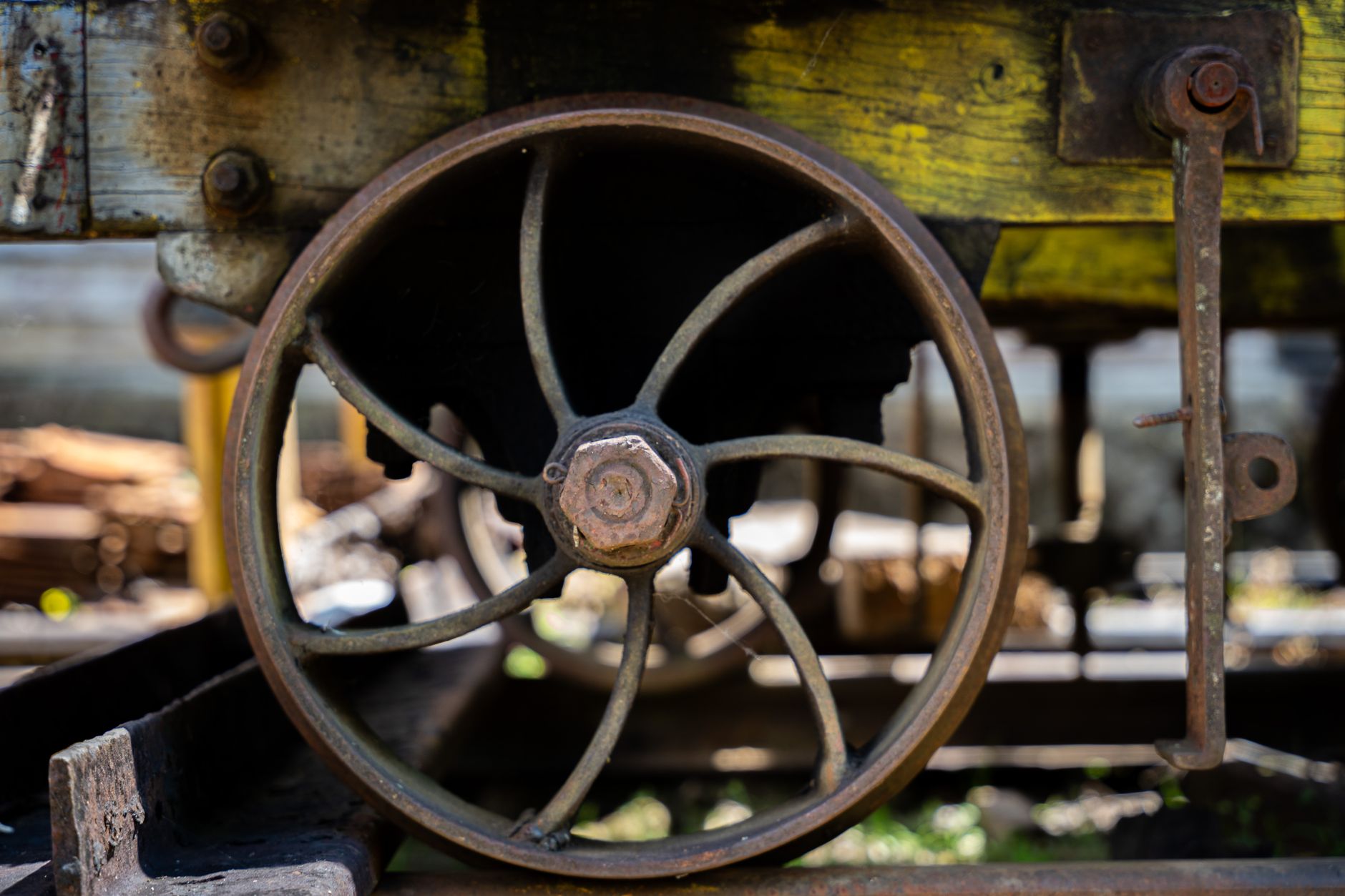
Plate for the exhibition on The Wheel
Illustrative photograph, not the original artifact. Photograph: Thilina Alagiyawanna / Pexels

About this date

Earliest evidence of wheeled vehicles comes from archaeology (a pictograph, a decorated pot and preserved wheels), not from any recorded invention. Dates are estimates.

About credit

The wheel has no known inventor. Wheeled vehicles appear within a few centuries of each other across a wide region, and scholars still debate where the idea first took hold.

Chapter I

The world before

Loads moved only as far as backs and sledges could drag them

For most of human history, anything heavy had to be carried, dragged on a sledge, or shifted on log rollers laid in front of it. Rollers had to be picked up from behind and laid down again at the front, a slow and labour-hungry process.

Settlements stayed close to what they needed. Harvests, stone, timber and clay travelled only as far as people and draught animals could drag them over rough ground.

The human achievement

An idea that needed an axle

A wheel alone is simple. The hard part is the wheel-and-axle: a fixed or rotating shaft fitted precisely through a hub so the load rides on the axle while the wheel turns. That demanded accurate woodworking and, probably, metal tools that could cut deep, clean joints.

Evidence is scattered and ancient: a pictograph of a wagon from Uruk in Mesopotamia, a pot from Bronocice in Poland with a wagon scratched on its side (both c. 3500–3350 BCE), and the Ljubljana Marshes wheel, found in 2002, about 70 centimetres across, made with an ash wheel and an oak axle. The potter’s wheel, used for shaping clay in Mesopotamia, appears at a similar time and may be related.

Later, light spoked wheels appear in steppe cultures around 2000 BCE, making fast chariots possible.

Understanding the invention

How it works

Why does a wheel make heavy loads easy to move? The answer is friction, and where it happens.

Step 01 of 04

Sliding friction is large

Dragging a load means its whole underside grinds along the ground. The heavier the load, the stronger that resistance.

IV

The transformation

What changed for humanity

  1. Trade & transport

    Bulk goods such as grain, stone and timber could travel overland between settlements, extending markets and the reach of cities.

  2. Agriculture

    Wheeled carts carried harvests and manure; the same principle later turned millstones and water wheels.

  3. Craft

    The potter’s wheel let makers produce more regular, thinner vessels at greater speed.

  4. War & power

    Chariots changed warfare in the second millennium BCE and helped states project military power.

It turned strength into distance: one animal could move far more weight, farther, than a person could carry. Carts, chariots, mills, gears and eventually railways all descend from it.

Before and after

Life before and after The Wheel

Before

Dragged on a sledge or shifted on log rollers by teams of people.

After

Hauled on a cart by one or two animals, over longer distances.

On larger screens, drag the divider (or use the arrow keys) to give more room to the world before or after.

VI

Its legacy

What came after

MHI 001

The Wheel

  • Beyond the collection

    Gears and mills

    Toothed wheels transferred and multiplied force in water mills, windmills and clockwork.

  • In this museum

    The Steam Engine

    Railway locomotives run on flanged iron wheels; engines use flywheels to keep their motion smooth.

  • In this museum

    The Airplane

    Landing gear, and the rotating propeller, rely on the same bearing-and-axle principle.

  • Beyond the collection

    Modern machinery

    Every turbine, motor and hard drive rotates around an axle.

VII

Human stories

The people and the moments

A wheel from a Slovenian marsh

The Ljubljana Marshes wheel was discovered in 2002 and radiocarbon-dated to about 3150 BCE. It is among the oldest wooden wheels known. It was built from different woods on purpose, with an ash wheel and an oak axle, which suggests its makers understood their materials.


Nobody signed it

Unlike later inventions, the wheel has no named inventor, patent or workshop. It survives only as objects and images left behind by people whose names we do not know.

Where accounts differ, this museum follows the documented record and says so.

Built with