Moore’s observation
Gordon Moore’s 1965 article predicting steady doubling later became known as Moore’s law, a goal that guided the industry for decades.
MHI 086 · Exhibition
1958–1959
Documented dateDallas, Texas and Mountain View, California, United States
Plate 086
1958–1959
Dallas, Texas and Mountain View, California, United States
Jack Kilby demonstrated an integrated circuit at Texas Instruments on 12 September 1958. Robert Noyce developed a silicon planar version at Fairchild in 1959.
Kilby and Noyce developed it independently; courts and companies eventually shared credit. Noyce died in 1990 and so was not eligible for the Nobel Prize.
The world before
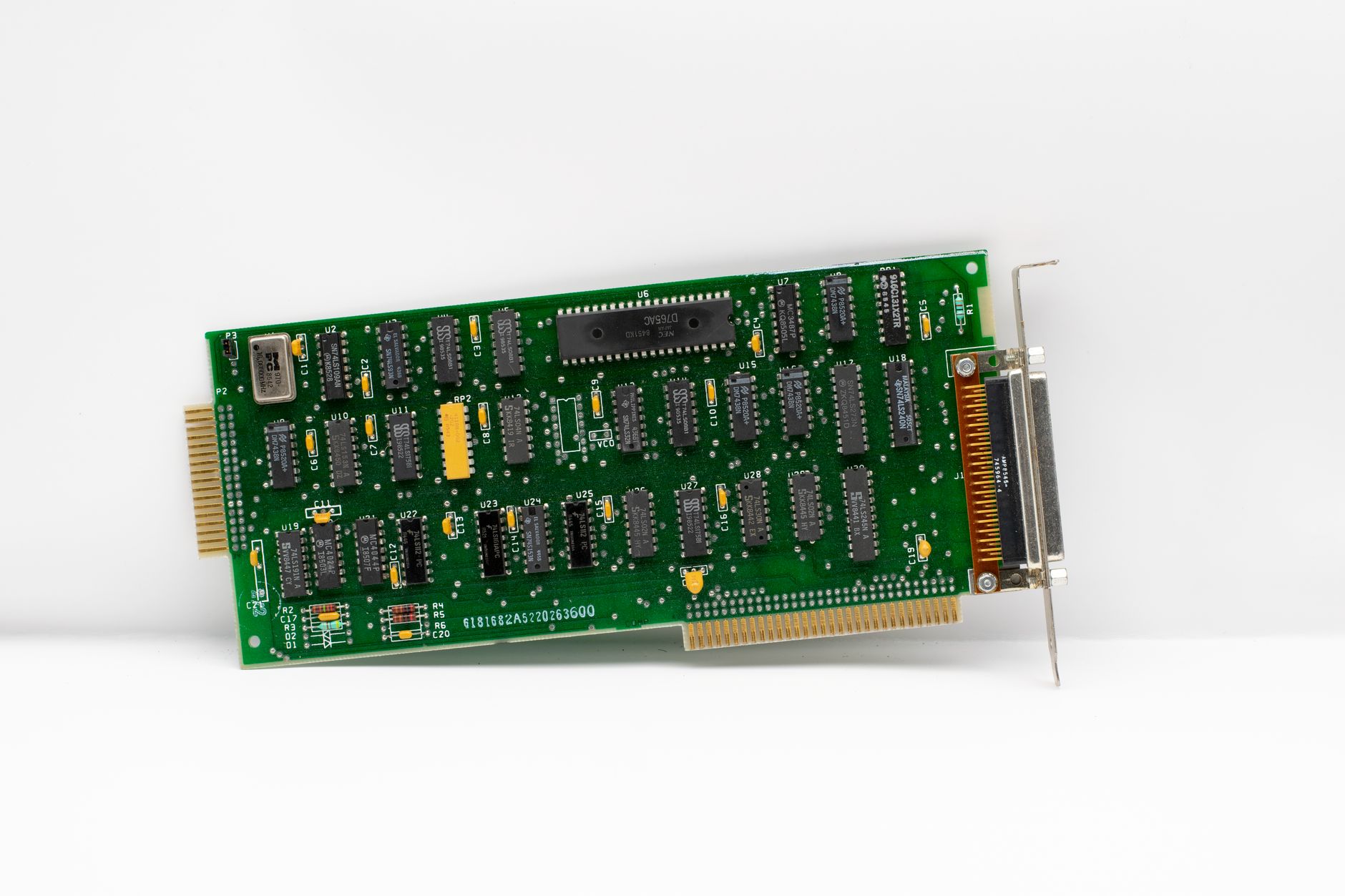
Circuits were assembled by hand, wiring thousands of components, which limited complexity and reliability.
The human achievement
Kilby built a working circuit on a piece of germanium with wires linking parts. Noyce’s planar silicon design laid metal lines on the chip itself, allowing mass production. In 1965 Gordon Moore observed that the number of components on a chip doubled about every year, later revised to every two years.
Understanding the invention
The Integrated Circuit, explained in two steps.
Step 01 of 02
Light and chemicals pattern layers on a silicon wafer, like printing.
IV
The transformation
From mainframes to personal computers and phones.
The semiconductor industry became central to global trade.
Chips made electronics small, cheap and reliable, and made the modern digital world possible.
Before and after
Before
Hand-wired boards.
After
One chip.
On larger screens, drag the divider (or use the arrow keys) to give more room to the world before or after.
VI
Its legacy
MHI 086
The Integrated Circuit
Beyond the collection
Mobile phones
Chips make them small enough to carry.
Human stories
Gordon Moore’s 1965 article predicting steady doubling later became known as Moore’s law, a goal that guided the industry for decades.
Where accounts differ, this museum follows the documented record and says so.
Next in the museum
Related exhibitions
 MHI 008The Computer1936–1948A computer stores instructions and data in memory and carries out calculations at electronic speed, following whatever program it is given.