Chaucer’s treatise
Geoffrey Chaucer wrote a Treatise on the Astrolabe in the 1390s for his young son Lewis, one of the earliest technical manuals in English.
MHI 038 · Exhibition
Ancient Greek origins; developed from the 8th century CE
Approximate dateHellenistic world, then Baghdad, Al-Andalus and beyond
Plate 038
Ancient Greek origins
Hellenistic world, then Baghdad, Al-Andalus and beyond
The planispheric astrolabe has Hellenistic roots. Islamic astronomers developed it extensively from the 8th century. Specific first makers are reputed but not securely documented.
The astrolabe is a product of several traditions. Different features were added in different places.
The world before
Astronomical calculations were done with tables and long computations.
The human achievement
The astrolabe projects the celestial sphere onto a flat plate. A rotating rete, a pierced star map, sits on top of plates engraved for specific latitudes. Sighting along a rule measures a star’s altitude, from which time or latitude can be read.
Understanding the invention
The Astrolabe, explained in two steps.
Step 01 of 02
The rete’s pointers mark bright stars, and turning it simulates the rotation of the sky.
IV
The transformation
Muslim astronomers used it to find prayer times and the direction of Mecca.
It was a standard tool for teaching astronomy in universities.
It combined many astronomical calculations in one hand-held tool and was used for timekeeping, surveying, astrology and finding prayer times and the direction of Mecca.
Before and after
Before
Estimating from the stars.
After
Reading it off a dial.
On larger screens, drag the divider (or use the arrow keys) to give more room to the world before or after.
VI
Its legacy
MHI 038
The Astrolabe
Beyond the collection
The Sextant
Specialised instruments for navigation followed.
Beyond the collection
Modern navigation
Celestial navigation developed from such instruments.
Human stories
Geoffrey Chaucer wrote a Treatise on the Astrolabe in the 1390s for his young son Lewis, one of the earliest technical manuals in English.
Where accounts differ, this museum follows the documented record and says so.
Next in the museum
Related exhibitions
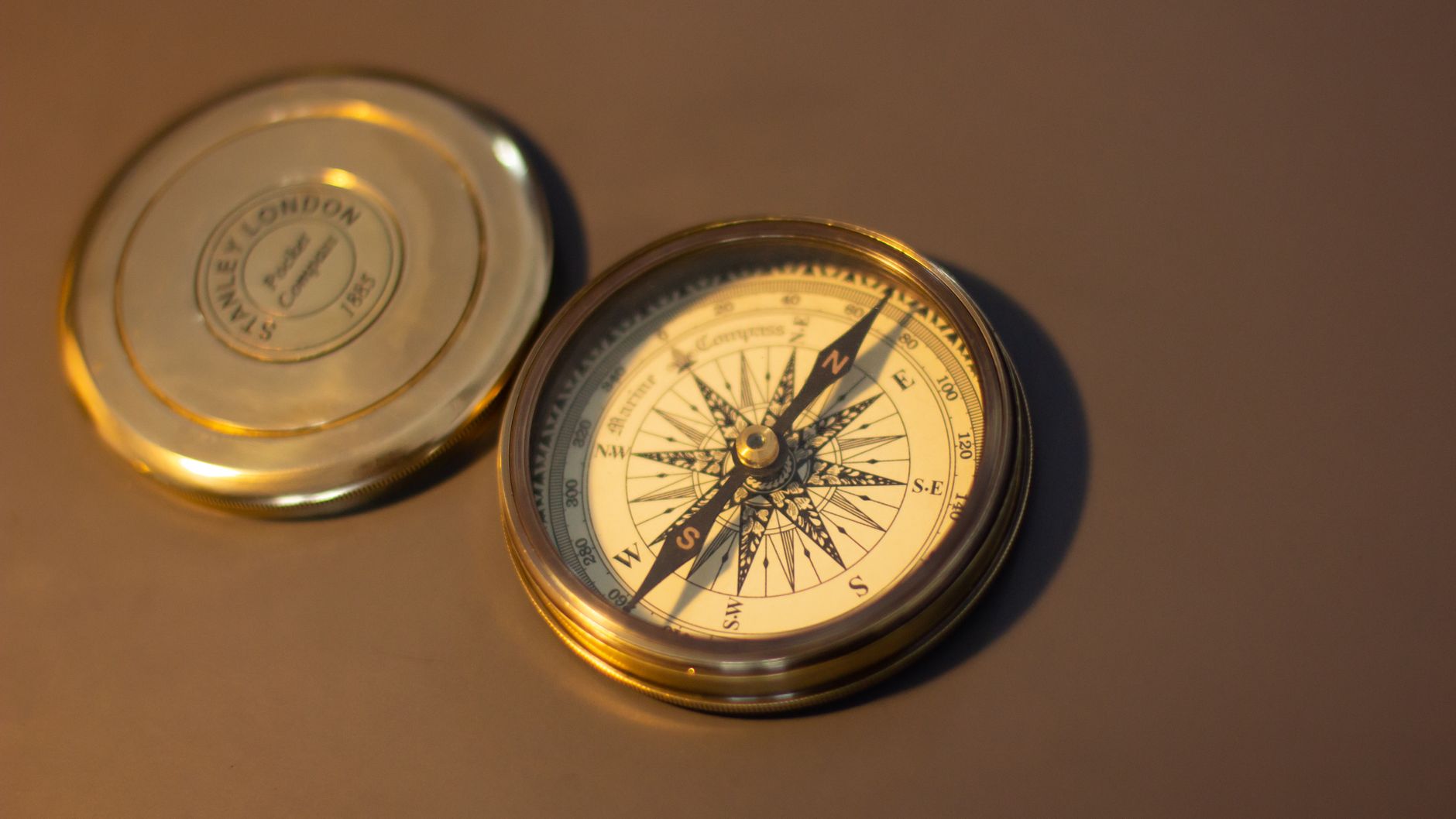 MHI 003The Compass11th–12th century (as a navigation tool)A magnetised needle free to turn aligns itself with Earth’s magnetic field, giving a fixed reference direction in any weather and any place.